
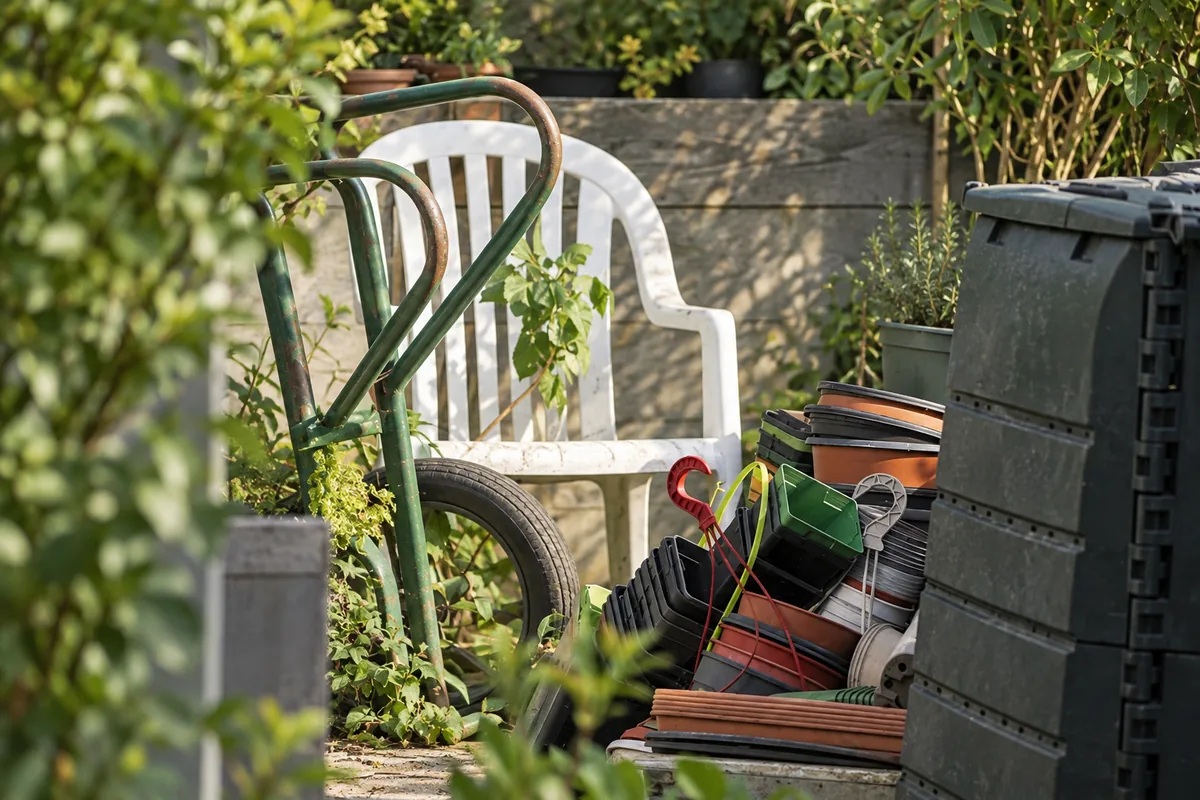
Separate green waste from the rest
List leaves, grass and cuttings separately from soil, rubble, timber, pots and furniture. A few bags of dense material involve different handling from a large heap of branches. Say what is already loose and what is still growing or fixed in place.
R4GM excludes soil from the food-and-garden bin. For suitable small amounts of cuttings, check your council service or home composting before paying for a larger container.
Useful next steps
Decide who will load the waste
A skip is useful when waste builds up during a project and you can load it safely. A collection suits an existing pile when you want the carrying and loading included. Compare the whole job, including the route from the garden.
Useful next steps
Estimate the pile in cubic metres
From a safe position, estimate the length, width and average height of the loose waste in metres. Multiply them for a rough volume. Split an irregular pile into a few simpler sections and add their estimates; do not climb on it or move sharp or unstable material to measure.
Worked example: a fairly even pile about 2 m long × 1.5 m wide × 0.8 m high is roughly 2.4 m³. This describes its loose volume, not its weight or a guaranteed packed load. List extra furniture or waste not included in those dimensions separately.
- Use the average pile height, not just its tallest branch.
- Mark hidden depth or contents as unknown.
- If more waste will be produced, include that in the estimate.
Compare volume, then check the loading limits
Skip capacity is often stated in cubic yards. For comparison, 4 yd³ is about 3.1 m³, 6 yd³ about 4.6 m³ and 8 yd³ about 6.1 m³. These are unit conversions, not recommendations for a particular material or garden.
For the 2.4 m³ example, compare capacities above that rough volume; a nominal 4 yd³ container is one size to discuss, not a confirmed fit. Awkward branches, extra waste and uncertainty may need more room. Use the supplier’s actual dimensions, loading line and material-specific weight limit; do not heap waste above the permitted fill level.
Soil and rubble need a weight check before choosing. A larger container does not automatically allow more heavy material. Check whether the supplier requires a separate load, a different size or a lower fill limit.
Useful next steps
Collection does not automatically include garden work
Cutting back plants, digging out roots and dismantling a shed are separate tasks from removing the loose material. Agree them before relying on a clearance price.
Do not break up unknown panels or roofing to make them fit. Suspected asbestos needs specialist advice and should stay undisturbed.
Check the material and the way in
A 2.4 m³ pile of branches and a smaller pile of soil need different checks. For branches, explain awkward lengths and whether you can load them safely. For soil or rubble, state the material and rough amount without guessing a weight. Photographs cannot establish a safe payload.
For a skip, describe the delivery entrance, ground, overhead obstructions and proposed position. The supplier must confirm access. In England and Wales, a skip on a public road needs a permit; it cannot go on the pavement. Confirm who arranges permission before delivery.
Useful next steps
Keep retained items and unusual materials clear
Identify planted tubs, tools and furniture that stay. Mention chemicals, gas bottles and unknown containers separately; do not empty or mix them. Neither a skip nor a garden collection automatically accepts every material.
Send one description that covers the full job
For example: ‘About 2.4 m³ of loose hedge cuttings, plus two broken chairs and separate bags of soil. The tubs stay. Access is through a side gate and down three steps.’ Add whether you want a container to load yourself or a team to collect it.
Confirm accepted contents, any separate handling, loading work and the complete charge. For a collection, include the carrying route rather than pricing all the materials as green waste.
Useful next steps
Your next steps
- Describe cuttings, soil, rubble and bulky items separately.
- Estimate loose-pile dimensions only where safe; leave hidden amounts unknown.
- Compare volume capacity, then confirm weight and loading limits.
- Check delivery space, permission and who will load the waste.
- Keep retained items and uncertain materials outside the agreed load.
Describe green waste, soil, rubble and bulky items separately. Tell us what is loose, what is still attached and the route from the garden.
Request my garden quoteSee your options before deciding. Nothing is booked yet.Common questions
What size skip do I need for garden clearance?
Estimate the loose volume and compare it with the supplier’s capacities. Then check the material-specific weight limit, level-fill rule and delivery access. A nominal size alone cannot confirm suitability, especially for soil, rubble or long branches.
Must everything be bagged?
Not to compare options or ask for a quote. Describe what is loose or bagged and agree preparation with the chosen provider. Do not create heavy bags merely to tidy the photo.
Can furniture go with the cuttings?
Name the furniture and material separately. Check acceptance before putting it in a skip or including it in a collection; upholstered items and unusual materials can need a different route.
Sources and further reading
Checked 13 October 2026. Follow the source links for current acceptance rules and local arrangements.
View all 7 sources
- Recycle for Greater Manchester: soil (opens in a new tab)
- Recycle for Greater Manchester: home composting (opens in a new tab)
- HSE: asbestos questions and guidance (opens in a new tab)
- GOV.UK: skip licences in England and Wales (opens in a new tab)
- HIPPO: published skip sizes and dimensions (opens in a new tab)
- HIPPO: loading and skip-hire guidance (opens in a new tab)
- GOV.UK: find a garden-waste collection in England or Wales (opens in a new tab)