
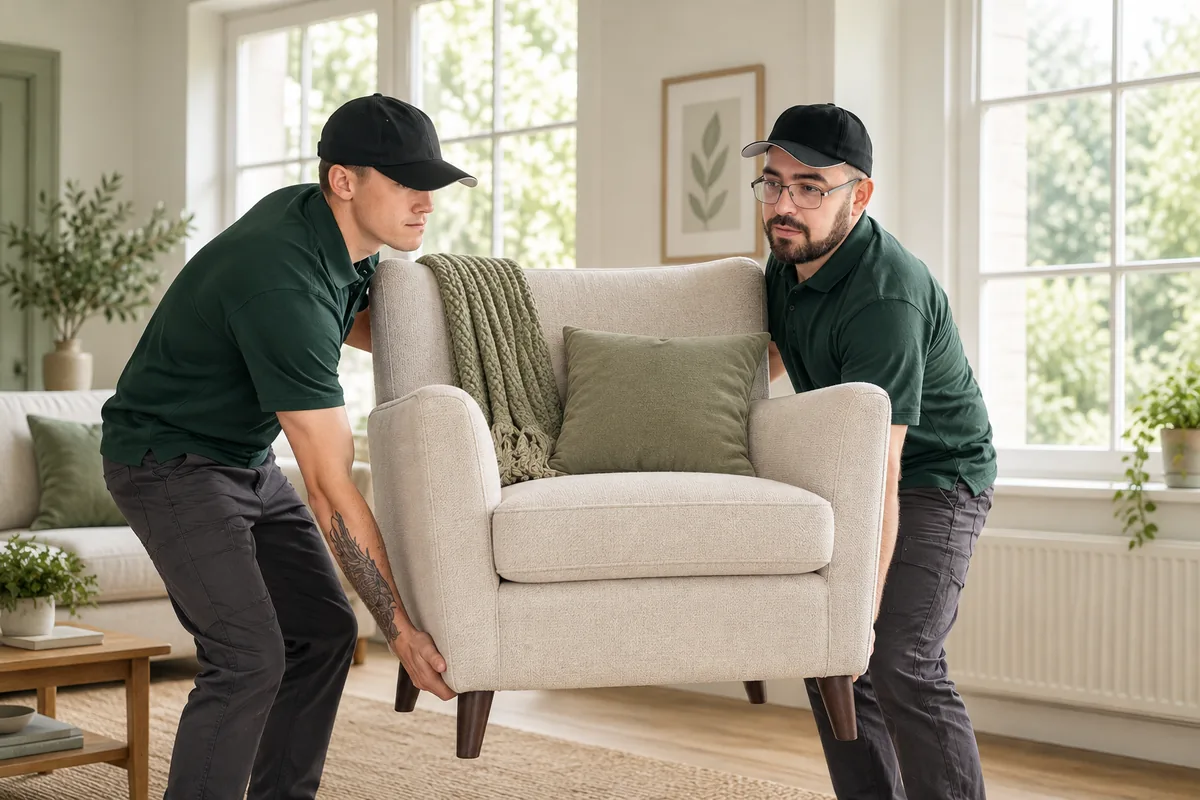
Match the route to the furniture you have
For useful furniture, compare selling, giving away and charity donation before arranging waste removal. If you are replacing it, ask the retailer about old-item take-back. Damaged pieces may suit council collection, an accepting recycling centre or paid removal.
You can use different routes for different pieces. For example, donate a usable dining set and arrange disposal for a damaged wardrobe; a single clear-out does not have to mean sending everything to the same destination.
Can a charity collect your furniture for free?
BHF’s postcode form lets you request a free collection of accepted donations. Check its item rules first: the furniture must be saleable, and upholstery needs fire labels. A charity collection is not a promise to clear everything you no longer want.
If selling or giving a piece away directly, describe its condition, dimensions and access honestly and agree the recipient’s transport. Keep a fallback plan if the arrangement falls through. A sale and a paid clearance are separate arrangements; confirm which service you are agreeing.
Useful next steps
Find council collection or a recycling centre
Use the council lookup to check accepted pieces, item limits, free allowances or charges, and the required collection point. A table and its chairs may not count as one item. Manchester City Council, for example, requires a roadside collection point and does not carry furniture from inside.
A recycling-centre trip may suit if you can safely transport the items. Use the R4GM finder for its participating boroughs and Wigan’s separate site information for Wigan. Check your address, item and vehicle rules first; a free drop-off option does not include transport.
Useful next steps
Ask the replacement retailer before delivery
Some retailers offer removal of old furniture as a separate service. Ask which pieces qualify, whether they must be dismantled or moved outside, and the total charge. A new-furniture delivery is not confirmation that the old furniture will be taken away.
For example, Furniture Village publishes its old-furniture collection partnership. If your main item is a sofa or mattress, the dedicated disposal guides cover those choices in more detail.
Useful next steps
Agree handling for damaged or awkward pieces
Mention glass, mirrors, broken fittings, heavy stone or unstable furniture. A piece fixed to a wall or assembled in a room may need extra work to remove; do not undo safety fixings or test-lift it for a quote.
Upholstered seating can require specialist treatment because of chemicals in its materials. Keep upholstery intact and do not assume every piece of furniture can be recycled together. The sofa guide explains this separately from donation conditions.
Useful next steps
If you choose paid removal
Paid help can suit a mixed list of furniture or pieces that need carrying out. Agree the items, floors, access and any dismantling. Keep furniture you are moving to another address on a separate list; unwanted-furniture clearance does not include that delivery.
WeMovers’ furniture collection service explains the scope and leads to a quote for the pieces together. Check accessible drawers for belongings and leave heavy furniture in place while making arrangements.
Useful next steps
Check who will take the furniture
For a private waste collection in England, check the collector’s registration using the official guidance below. Ask about the intended disposal destination when comparing providers; a claim that something is recyclable is not proof of where your collection will go.
Keep the agreed list and collection details. With WeMovers, payment is on completion. A waste transfer note can be provided; confirm any records you need when arranging collection.
Your next steps
- Decide which pieces are usable and which need disposal.
- Check the recipient or collector’s acceptance before arranging a date.
- Compare collection location, dismantling and the full charge.
- Keep belongings and furniture that are staying clearly separate.
List the furniture you want removed and tell us about access and any dismantling. We’ll review the details before confirming your quote.
Request my furniture quoteSee your options before deciding. Nothing is booked yet.Common questions
Can all my furniture be removed for free?
Not automatically. Accepted donations or local council allowances can help, but condition, item limits, collection point and your address matter. Use the charity and council checks above before relying on a free option.
Will a clearance company pay me for furniture?
A paid clearance and a sale are different arrangements. If a piece may sell, arrange that separately and check the written terms of any offer.
What if taking it apart might damage it?
Explain its condition and construction before agreeing dismantling. Do not promise a piece for reuse if it might not remain usable; agree the removal plan without undoing safety fixings yourself.
Sources and further reading
Checked 12 October 2026. Follow the source links for current acceptance rules and local arrangements.
View all 9 sources
- BHF: furniture donation conditions (opens in a new tab)
- Manchester City Council: bulky-item collection arrangements (opens in a new tab)
- GOV.UK: household waste and checking a private collector (opens in a new tab)
- Environment Agency: waste upholstered seating (opens in a new tab)
- BHF: check your area and request a free donation collection (opens in a new tab)
- GOV.UK: bulky-item collection lookup (England and Wales) (opens in a new tab)
- Recycle for Greater Manchester: centres, eligibility and vehicle rules (opens in a new tab)
- Wigan Council: waste and recycling centres (opens in a new tab)
- Furniture Village: old-furniture removal FAQ (opens in a new tab)