
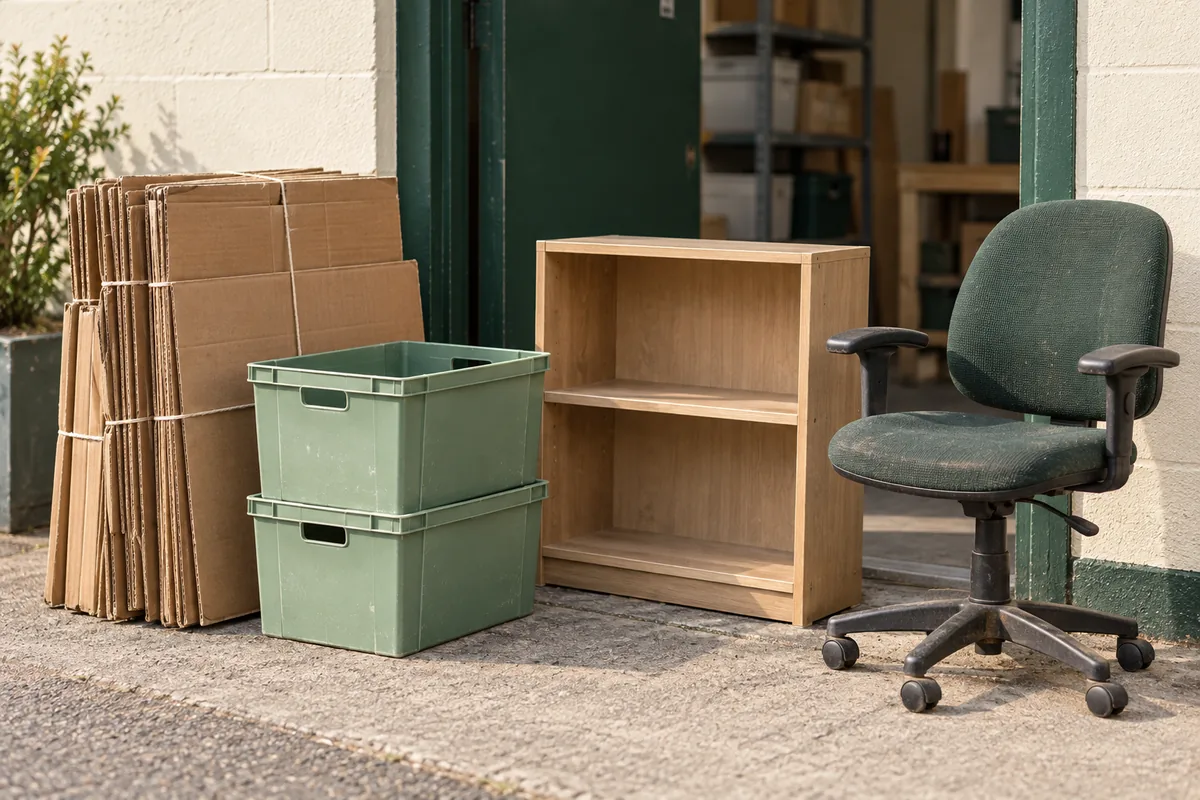
Start with where the waste came from.
Waste from trading activity remains business waste even if it is a small quantity or comes from a home-based business. Identify its source, what it contains and whether anything may be hazardous.
First consider what can be avoided or kept in use. For the remainder, separate the materials, provide secure storage and choose an appropriate authorised collection. England’s workplace dates and separation rules below must not be applied automatically in the other UK nations.
Useful next steps
Separate a clear-out from a regular service.
For a one-off job, describe the complete amount and any deadline for releasing the space. For a recurring need, describe what builds up, the typical amount and the frequency you want.
Ask what an ongoing arrangement would include: accepted streams, collection frequency, storage arrangements and what happens when quantities change. WeMovers offers a regular arrangement only where the requirements can be supported. Sending a request does not create a recurring contract.
Check the workplace recycling requirements.
In England, workplace arrangements must separate food waste, dry recycling and residual waste. Micro-firms with fewer than ten full-time equivalent employees have until 31 March 2027; the test is across the business rather than each site. Check the official guidance for how staff are counted.
Paper and card should be collected apart from glass, metal and plastic. An exception requires the collector’s written assessment of the permitted reasons for collecting them together. Ask the collector which arrangement applies; choosing one mixed bin yourself is not that assessment.
A bulky clear-out does not replace routine recycling arrangements. Tell your staff which material goes where and follow the agreed separation instructions.
How can a business dispose of cardboard?
Reuse suitable boxes first. For waste card, agree a commercial recycling collection and follow the collector’s preparation rules. Tell them if packaging is food-soiled, coated or mixed with other materials so it is not silently treated as clean cardboard.
- Provide a labelled, secure place for card, away from food and liquids; protect it from rain.
- Remove other packaging and empty the boxes. Flatten them if your collector requests it; do not use equipment you are not trained to operate.
- Check the container, any contamination exclusions and how much card builds up between collections.
- Agree whether paper and card are separate or covered by the collector’s valid co-collection assessment.
- Keep the transfer record and review the arrangement if volumes change.
Useful next steps
Raise uncertain materials before collection.
Identify chemicals, oils, batteries, paint containers, fridges, other electrical equipment and unknown liquids. Some waste needs specialist handling or cannot be accepted through the proposed service. A general business-waste quote is not approval to collect every material.
Keep uncertain contents undisturbed and describe what is already safely visible. Do not open containers or mix materials to make the pile smaller. Ask which waste can be accepted and whether separate arrangements are required.
Compare the work behind the price.
Compare providers using the same material streams, amounts and frequency. Check containers, accepted contents, access and loading restrictions alongside the total charge. Do not compare a one-off mixed clear-out with a recurring recycling contract as if they cover the same work.
For WeMovers, describe the waste and the collection you need. Regular arrangements and unusual streams need confirmation before they are included. Additional material or changed access may alter the agreed scope.
Useful next steps
Check the collector and keep the paperwork.
Check the waste carrier’s registration and agree where the accepted waste is going. For non-hazardous transfers, complete the required transfer document with an accurate description and keep it for two years. Qualifying recurring transfers can use the arrangements described in the official guidance; hazardous waste has separate documentation requirements.
With WeMovers, payment is due on completion and a waste transfer note is supplied for every collection. Raise any additional records your organisation requires before agreeing the service.
Useful next steps
Your next steps
- Use the rules for the country where the waste is produced.
- Reduce or reuse first, then identify each remaining material.
- Separate and store waste securely in suitable labelled containers.
- Check the collector, accepted streams, frequency and complete price.
- Complete and retain the required transfer records.
Describe each waste stream, the quantities and access. Tell us whether you need a one-off clearance or would like to discuss regular collections.
Request my business waste quoteSee your options before deciding. Nothing is booked yet.Common questions
How can a business dispose of cardboard?
Reuse suitable boxes, then arrange a commercial recycling collection for the waste card. Keep it secure and free from food or liquid contamination, follow preparation rules and confirm the paper/card separation arrangement. The cardboard checklist above covers storage, quantities and records.
Do you collect every type of trade waste?
No blanket acceptance applies. Describe each material, especially heavy, unusual or potentially hazardous waste, so acceptance and handling can be checked.
Can I book regular collections online?
Describe the recurring need in the request. Frequency, materials, capacity and service arrangements must be confirmed before an ongoing service can be offered.
Sources and further reading
Checked 12 October 2026. Follow the source links for current acceptance rules and local arrangements.
View all 9 sources
- GOV.UK: disposing of business or commercial waste (opens in a new tab)
- GOV.UK: workplace recycling in England (opens in a new tab)
- GOV.UK: hazardous waste (opens in a new tab)
- GOV.UK: waste transfer notes (opens in a new tab)
- GOV.UK: hazardous waste producers and holders (opens in a new tab)
- GOV.UK: safe storage of business waste (opens in a new tab)
- SEPA: waste guidance for Scotland (opens in a new tab)
- Natural Resources Wales: waste management (opens in a new tab)
- DAERA: waste guidance for Northern Ireland (opens in a new tab)